Who is speaking for the Engineer at the decision-making table?
Kenya is building at an unprecedented pace. We see highways stretching across counties, water systems expanding into arid regions, renewable energy projects redefining our power mix, affordable housing reshaping urban skylines. Engineers are at the centre of it all.
And yet, a difficult question persists:
Are engineers truly at the centre of national decision-making?
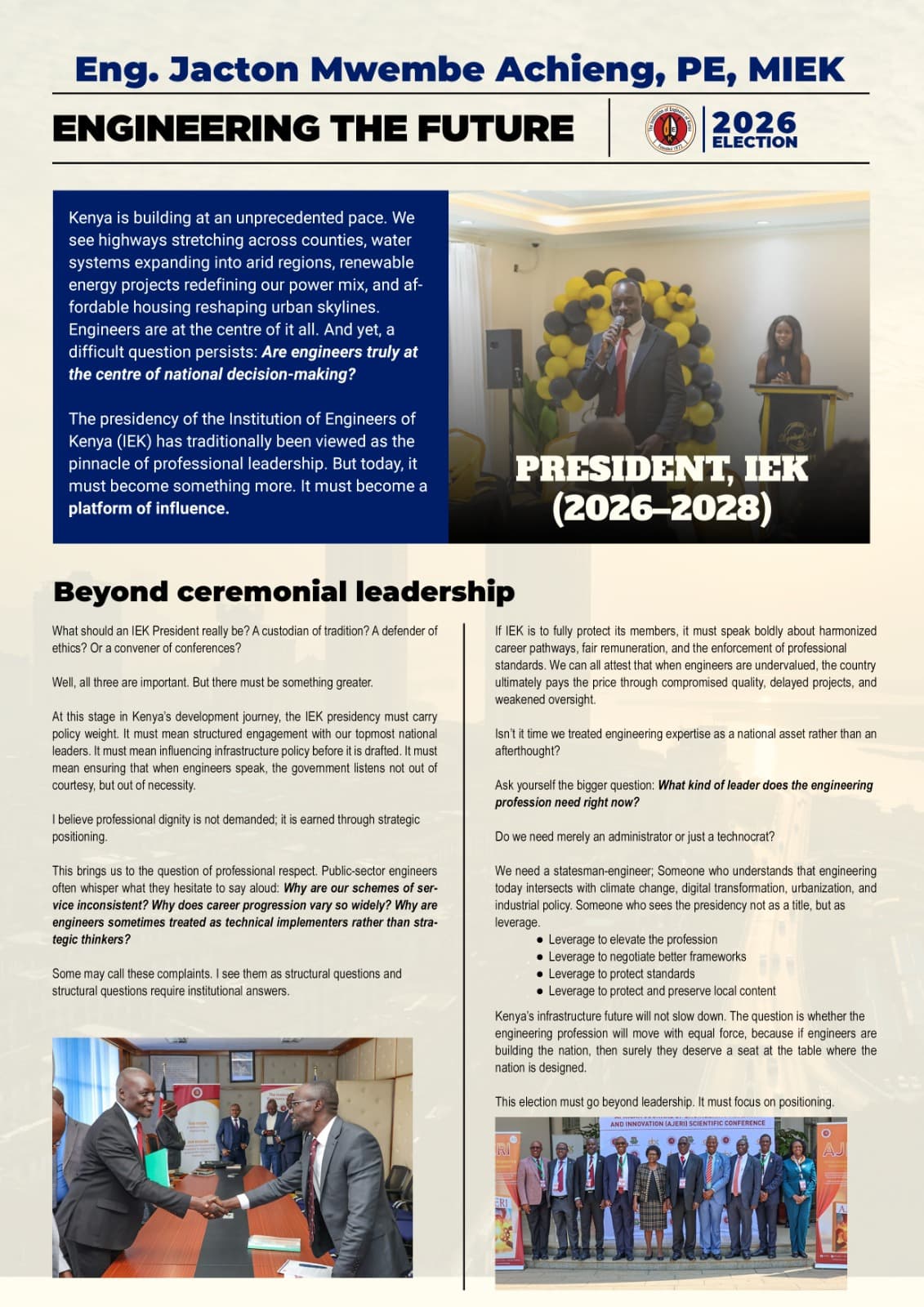
The presidency of the Institution of Engineers of Kenya (IEK) has traditionally been viewed as the pinnacle of professional leadership. But today, it must become something more. It must become a platform of influence.
Beyond ceremonial leadership
What should an IEK president really be? Is it custodian of tradition? Or a defender of ethics? or a convener of conferences?
Well, all the three are key, but there has to be something greater to it.
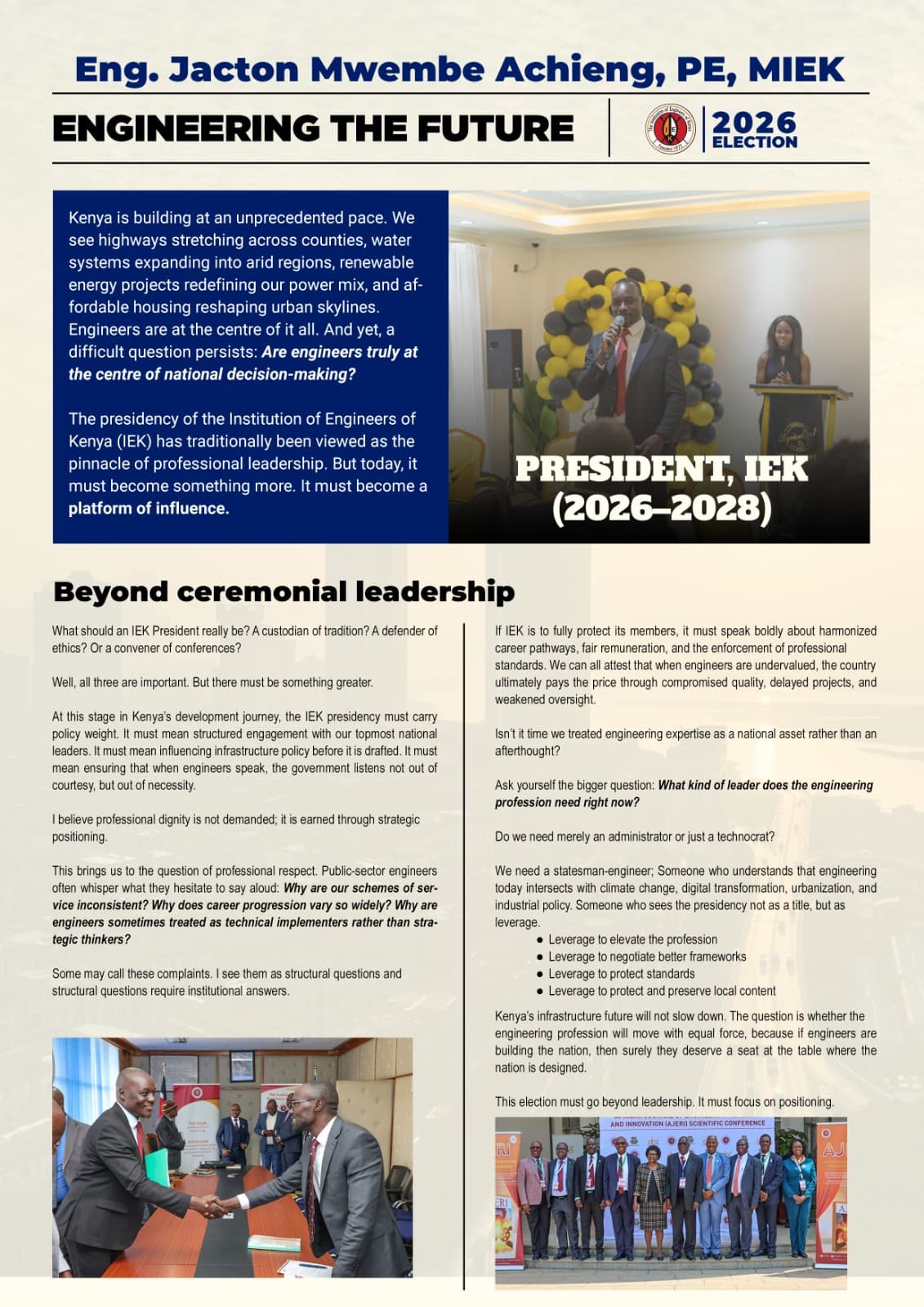
At this stage in Kenya’s development journey, the IEK presidency must carry policy weight. It must mean structured engagement with our top most leaders. It must mean influencing infrastructure policy before it is drafted. It must mean ensuring that when engineers speak, the government listens, not out of courtesy, but out of necessity.
I believe that professional dignity is not demanded. It is earned through strategic positioning.
This brings us to the question of professional respect. Public-sector engineers often whisper what they hesitate to say loudly:
Why are our schemes of service inconsistent? Why does career progression vary so widely? Why are engineers sometimes treated as technical implementers rather than strategic thinkers?
Some may say these are complaints. However, I see them as structural questions. And structural questions require institutional answers.
If IEK is to fully protect its members, it must speak boldly about harmonized career pathways, fair remuneration, and the enforcement of professional standards. We all can attest to the fact that when engineers are undervalued, the country ultimately pays the price through compromised quality, delayed projects, and weakened oversight.
Isn’t it time we treated engineering expertise as a national asset rather than an afterthought?
Ask yourself the big question:
What kind of leader does the engineering profession need right now?
Do we need merely an administrator or just a technocrat.
We need a statesman-engineer; Someone who understands that engineering today intersects with climate change, digital transformation, urbanization, and industrial policy. Someone who sees the presidency not as a title, but as leverage.
- Leverage to elevate the profession.
- Leverage to negotiate better frameworks.
- Leverage to protect standards.
- Leverage to protect and preserve local content.
Kenya’s infrastructure future will not slow down. The question is whether the engineering profession will move with equal force.
Because if engineers are building the nation, then surely, they deserve a seat at the table where the nation is designed.
This election should be beyond leadership; we need to focus on positioning.
Media Gallery